Countdown: 12 Months — A Survival Guide to the 2026 Financial Storm
Making money isn’t magic; it’s about spotting the signals. Here is the macro truth that school never taught you.
You see people raking in cash while you’re grinding away at your 9-to-5, and it feels unfair. But let’s be real — it’s rarely just luck. It’s because they understand leverage. They spot the signals. They play by a set of wealth rules that most people never learn.
Today, I want to rip off the “mainstream media” filter. As a strategic analyst, I’m going to show you what’s really happening underneath this market rally. We are staring down the barrel of a macro shift that’s going to decide the fate of every investor out there.
This isn’t a drill. It’s the final warning before 2026.
1. History Rhymes: The “Un-Inversion” is the Real Trap
Mark Twain famously said, “History doesn’t repeat itself, but it often rhymes.”
Right now, the most reliable alarm bell in macroeconomics — the Yield Curve — has given us its final notice.
Here’s the basic idea: In a normal world, if you lend money for ten years, you should get paid more interest than if you lend it for a month. It’s riskier, right? But when short-term rates get higher than long-term rates, we call it an “inverted curve.” It means the big money is terrified of the future.
But here’s the kicker: The inversion itself isn’t what kills you. It’s the “un-inversion.”
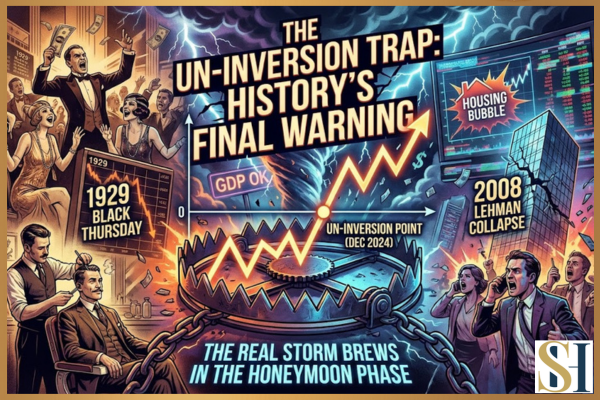
In December 2024, after more than 700 days — a record-breaking streak — the curve finally un-inverted. That sounds like good news, like things are going back to normal. But look at the track record. It’s chilling.
- Before the 1929 Great Depression: The curve un-inverted, and the market went nuts. It was the “Roaring Twenties.” Even barbers were giving stock tips. Everyone thought the party would never end. Then came Black Thursday. The Dow dropped 89%, and an entire generation got wiped out.
- The 2008 Crisis: The curve inverted in 2006. But the stock market held on for another 657 days, even hitting new highs. People were shouting, “This time is different!” right until Lehman Brothers collapsed overnight.
So, where are we now? We are in that weird twilight zone. GDP looks okay. Stocks are near highs. It feels like a honeymoon phase. But history tells us this is exactly when the real storm starts brewing.
2. The Cracks in the Foundation: $1.2 Trillion in Debt
We talk about this a lot in our internal meetings at Senhai Lab. Global debt has hit a point where it just doesn’t make sense anymore. The economy looks shiny on the outside, but the load-bearing walls are cracking.
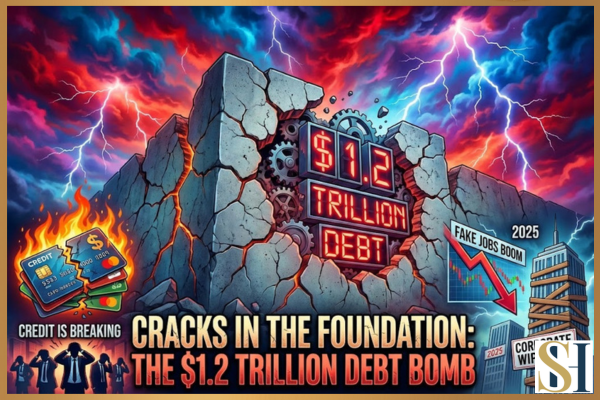
- Credit is Breaking: Total US credit card debt just hit a record $1.2 trillion. But here’s the scary part — it’s not just people struggling at the bottom. Default rates in high-income neighborhoods have spiked by 73%. When the middle class and the wealthy start missing payments, you know something is wrong.
- The “Fake” Jobs Boom: Look at the November 2025 non-farm payrolls. Way below expectations. Unemployment crept up to 4.6%. Plus, 5.4% of the population is now working multiple jobs just to get by. If one job can’t feed you, that’s not a strong economy.
- Corporate Wipeouts: In the first half of 2025, we saw the highest number of “super bankruptcies” (companies with over $1 billion in assets) since 2010.
3. 2026: The Changing of the Guard and the “Midterm Curse”
From our vantage point, late 2025 to early 2026 is going to be a dangerous window.
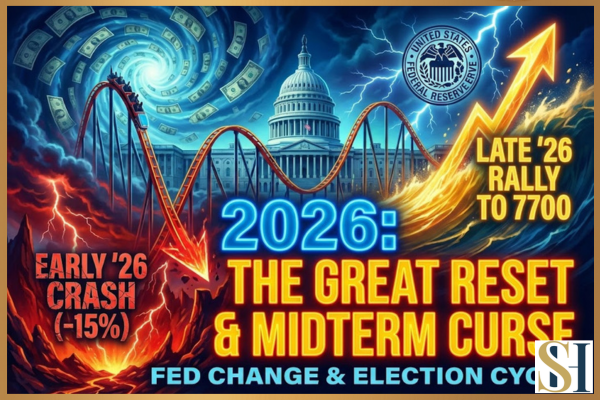
Does that mean you should sell everything and bury gold in your backyard? No. Because 2026 is bringing two massive events that will shake things up:
Act 1: The Fed’s “Great Reset”
Jerome Powell’s term ends in May 2026. The frontrunners to replace him (like Kevin Hassett) tend to be doves. They are the types who will slash interest rates even if inflation is heating up. When the power shifts, expect a lot of volatility, followed by a massive injection of cash into the system.
Act 2: The Midterm Election Cycle
There’s a pattern traders call the “Midterm Curse.” The year before an election usually sees a drop of 10% or more. But here’s the silver lining: In the 12 months after the election, the S&P 500 rallies an average of 14.8%.
My call? We might see a nasty 10–15% correction in early 2026. It’s going to flush out the gamblers. But by the end of the year, with fresh liquidity, I wouldn’t be surprised to see the S&P 500 run toward 7700.
4. Your Only Advantage in the AI Era: Time
Everyone wants to invest like Elon Musk. But Musk doesn’t buy ETFs. He builds businesses. He used SpaceX to change the game.
For the rest of us, trying to outsmart the market with “analysis” is getting harder. AI can read 100 balance sheets in a minute. You can’t compete with that speed.
Your only real edge is Time Arbitrage. Big institutions have to show profits every quarter. You don’t. You can afford to sit on a loss for three years waiting for the cycle to turn.
As Warren Buffett put it, his secret isn’t predicting the future perfectly. It’s about:
“Always keeping a margin of safety.”
Here is the defensive strategy we suggest at Senhai Lab:
- Don’t Panic Sell: History proves the first year after a bear market brings the biggest gains. Selling everything at the bottom is financial suicide.
- Digital Gold & Hard Assets: Keep buying broad market ETFs to capture the average growth. But hedge your bets. Gold helps when fiat currency gets weak, and Bitcoin is your insurance against liquidity floods.
- Cash is King (For Now): Keep 6 to 12 months of living expenses in cash. You don’t hold this for profit; you hold it so you’re never forced to sell your good assets when the market is crashing.
Conclusion: Are You the Hunter or the Prey?
At this turning point, wealth isn’t disappearing. It’s just moving. It’s being redistributed.
The people who are ready will see this as the opportunity of a lifetime to buy cheap. The people who aren’t ready? They’re just fuel for the fire.
Stop playing this game with a blindfold on. Watch the signals. Respect the cycles. That is how you survive — and thrive — in the storm of 2026.